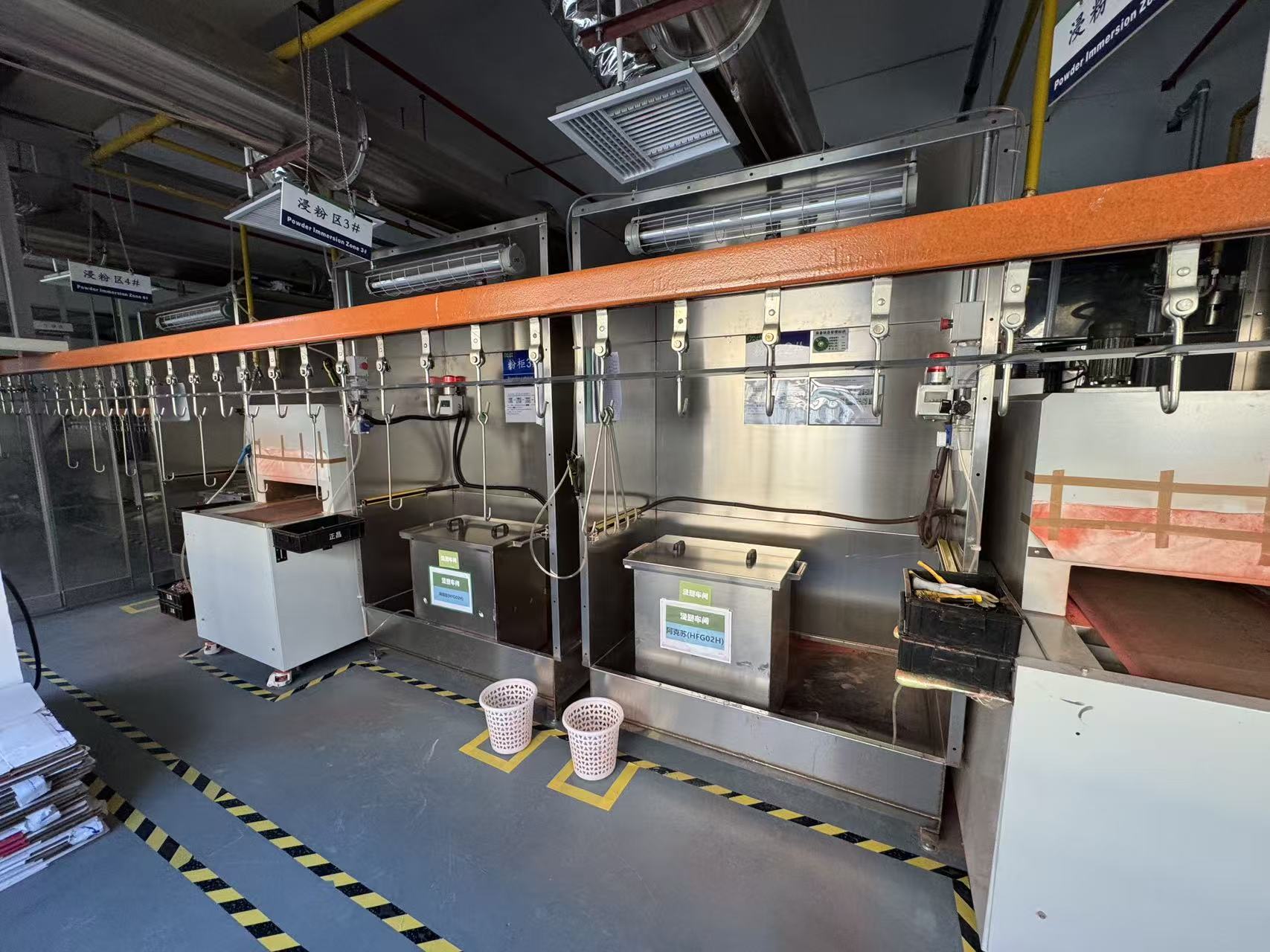
打磨 / 去毛刺:重点处理连接件的孔洞边缘、拼接处,去除氧化层、油污和尖锐毛刺,避免涂层附着不均。
脱脂清洗:用碱性脱脂剂或环保清洗剂浸泡(5-10 分钟),或超声清洗,彻底去除加工残留油污和粉尘。
漂洗干燥:用清水冲洗残留清洗剂,再经 80-100℃低温烘干(10-15 分钟),确保孔洞、缝隙无水分残留。
将干燥后的连接件铜排放入烘箱,预热温度控制在 130-170℃。
预热时间根据连接件厚度和孔洞数量调整(8-20 分钟),确保铜排及孔洞内部温度一致。
目的是提升粉末熔融速度,避免因连接件结构复杂导致涂层附着力不足。
选用适配的热塑性浸塑粉(如 PVC、PE 或阻燃型粉末),倒入浸塑槽并搅拌均匀。
手动或借助夹具固定连接件铜排,将其完全浸入粉末槽,停留 5-12 秒(孔洞较多时可适当延长)。
缓慢垂直提起,轻轻抖动去除多余粉末,确保涂层厚度均匀(常规 0.8-2.5mm),孔洞边缘无积粉。
将浸塑后的连接件铜排放入固化烘箱,升温至 185-230℃。
固化时间 20-35 分钟,根据涂层厚度和连接件复杂度调整,保证粉末完全熔融、流平并固化。
固化过程中避免堆叠,保持连接件间距,防止涂层粘连或破损。
冷却:自然冷却至室温(或风冷加速),避免高温修整导致涂层变形。
修整:用专用工具清理孔洞内、边角处的多余积粉和飞边,确保连接件装配尺寸达标。
检验:检测涂层厚度、附着力(划格试验),检查是否有气泡、漏涂、裂纹等缺陷,合格后入库。
Pretreatment: Targeted cleaning of the copper busbar surface of connectors
Grinding/Deflashing: Focus on treating the hole edges and joints of connectors to remove oxide layers, oil stains and sharp burrs, avoiding uneven coating adhesion.
Degreasing and Cleaning: Soak in alkaline degreaser or environmentally friendly cleaning agent for 5-10 minutes, or use ultrasonic cleaning to thoroughly remove residual oil stains and dust from processing.
Rinsing and Drying: Rinse residual cleaning agent with clean water, then bake at a low temperature of 80-100℃ for 10-15 minutes to ensure no moisture remains in holes and gaps.
Preheating: Uniform temperature rise adapted to connector structure
Put the dried connector copper busbars into an oven, with the preheating temperature controlled at 130-170℃.
The preheating time is adjusted according to the thickness of connectors and the number of holes (8-20 minutes) to ensure consistent temperature inside the copper busbars and holes.
The purpose is to increase the powder melting speed and avoid insufficient coating adhesion caused by the complex structure of connectors.
Dip Coating: Balancing uniformity and structural adaptability
Select a suitable thermoplastic dip coating powder (such as PVC, PE or flame-retardant powder), pour it into the dip coating tank and stir evenly.
Fix the connector copper busbars manually or with fixtures, completely immerse them in the powder tank, and stay for 5-12 seconds (the time can be appropriately extended for connectors with more holes).
Lift vertically slowly and shake gently to remove excess powder, ensuring uniform coating thickness (conventional 0.8-2.5mm) and no powder accumulation on hole edges.
Curing: Ensuring complete curing of complex structures
Put the dip-coated connector copper busbars into a curing oven and raise the temperature to 185-230℃.
The curing time is 20-35 minutes, adjusted according to the coating thickness and connector complexity, to ensure the powder is completely melted, leveled and cured.
Avoid stacking during the curing process and maintain spacing between connectors to prevent coating adhesion or damage.
Post-treatment: Precise trimming and quality inspection
Cooling: Cool naturally to room temperature (or accelerate with air cooling) to avoid coating deformation caused by trimming at high temperature.
Trimming: Use special tools to clean excess powder and flash inside holes and at corners to ensure the assembly dimensions of connectors meet the standards.
Inspection: Test the coating thickness and adhesion (cross-cut test), check for defects such as bubbles, missing coating and cracks, and store the qualified products in the warehouse.
L3000xW200超大母排全自动浸塑线-L3000×W200 Extra-Large Busbar Full-Automatic Dip Coating Line
手动母排铜排铝排浸塑线-Manual busbar (copper busbar/aluminum busbar) dip coating line
低中高温隧道烘烤炉-Low-Medium-High Temperature Tunnel Oven
特氟龙网带隧道烘干线-Teflon Mesh Belt Tunnel Drying Line
隧道烘干烤炉-Tunnel Drying Oven
隧道烘干炉-Tunnel Drying Line
双开门电加热烤箱-Double-Door Industrial Electric-Heated Oven
工业双门电加热LED烘箱-Industrial Double-Door Electric-Heated LED Oven
首页
电话
留言
回到顶部